
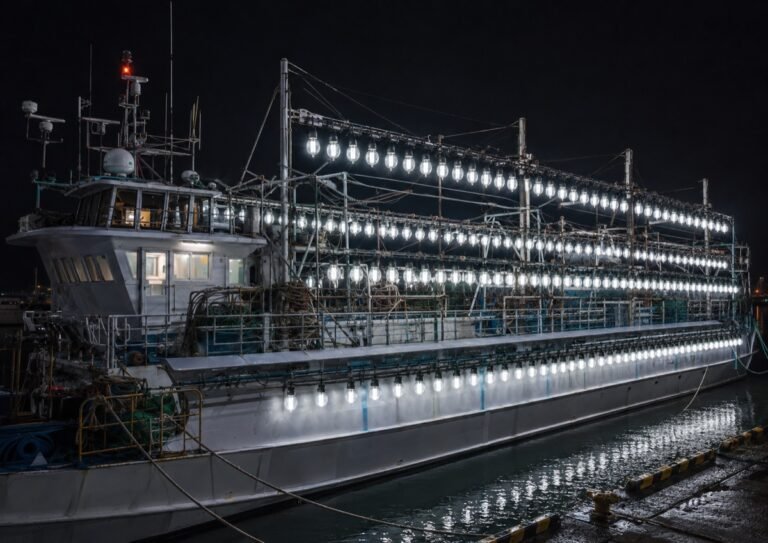
A vessel lighting layout starts with the fishing method. A squid jigger needs a useful light field around the jigging lines; a purse seiner needs an aggregation zone and clear working space during setting and hauling. Copying another boat’s lamp count without its deck geometry, generator capacity or fishing ground often creates bright spots and wasted spill.
Map the vessel before specifying lamps
Make a simple plan showing beam, rails, jigging machines or net-handling equipment, wheelhouse sightlines, navigation lights, mounting heights and cable routes. Mark where crew must see hooks, ropes and winches, and where attracting light should reach the water. Record existing lamp power, beam direction and any dark or overlit areas. Photographs taken from sea level and from the bridge help expose glare that a deck drawing misses.
Squid jiggers: build an even water-side field
Above-water side arrays can be divided into port and starboard groups so the skipper can adjust output for fishing position and conditions. Check aim from the actual mounting height, with sufficient overlap to avoid sharp gaps at the jigging lines. Preserve maintenance access and keep light away from the helmsman’s direct sightline. Any proposed underwater element is a separate product and electrical scope; abylure’s current IP67 platform is for above-water installation.
Purse seiners: plan around the operation sequence
Identify the gathering zone, skiff or net deployment path, and the places where crew need task lighting. Separate attracting-light circuits from deck work lights where practical, so a change in fishing-light output does not plunge a hauling station into darkness. Check the light pattern during set, pursing and retrieval, not only at anchor or during a static dock test.
Choose a testable starting configuration
- Model the existing and proposed electrical load.
- Request photometric data and a proposed aiming plan for the chosen power class.
- Fit a limited trial group before replacing the whole array.
- Record surface light distribution, crew visibility, fuel use and catch per unit effort across comparable nights.
- Adjust the layout before fleet-wide rollout.
Research in squid jigging has shown that more lamps do not produce a proportional catch increase. Layout and the fishing operation should therefore be evaluated together. See the 500W–1000W series and send a deck plan and current lamp schedule for a vessel-specific proposal.