
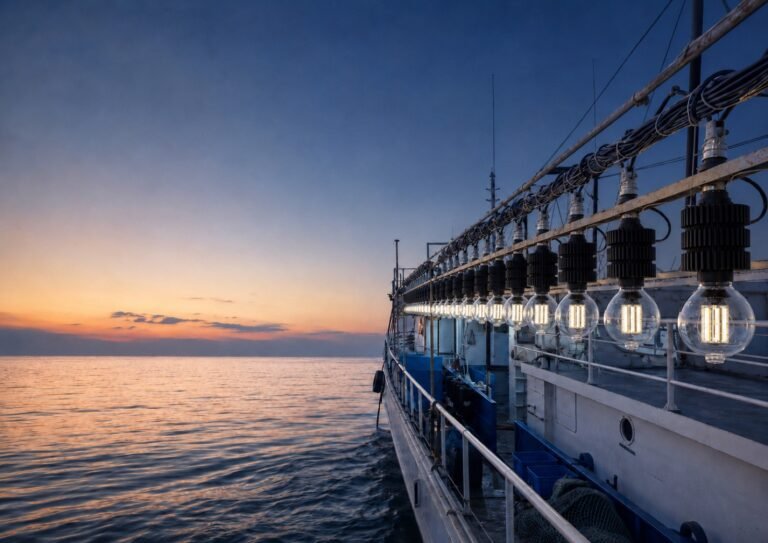
There is no universal “best colour” for every squid vessel. Light has to pass through the local water column, interact with prey and squid behaviour, and form a useful illumination pattern around the jigs. A colour that works in clear offshore water may not perform the same way in a turbid coastal ground.
Penetration is only one part of the answer
Water absorbs red wavelengths strongly, while blue and blue-green light often travels further in clear ocean water. Suspended particles and dissolved matter change that relationship. NOAA uses attenuation at 490 nm as one indicator of how blue-green light penetrates a water column; a higher attenuation coefficient means shallower penetration. The relevant figure is therefore the measured light field at fishing depth, not the colour name printed on a lamp carton.
What squid-fishing studies actually show
Squid responses vary by species, season, fishing ground and light arrangement. Research on coastal squid jigging found that catch did not simply rise in proportion to the number of metal-halide lamps. Another field analysis found captain and crew fishing ability, moon phase and dolphins important in explaining catch. A small blue-versus-green trial reported better blue-light results in its local setting, but its sample does not establish a worldwide ranking. These findings support trial design, not a blanket promise of higher yield from any one spectrum.
Run a useful onboard A/B trial
- Choose comparable fishing nights and record location, water clarity, moon phase, weather and target species.
- Keep jig type, crew routine, aiming geometry and lighting power as consistent as possible.
- Measure illumination at the surface and, where practical, at working depth.
- Log catch per fishing hour and catch per litre of fuel, not catch alone.
- Repeat across enough nights to separate light effects from changes in abundance.
White light is a useful reference when replacing existing broad-spectrum lamps; blue or green configurations may be evaluated for a specific ground. The light’s beam pattern and the vessel’s working method can matter as much as its nominal spectrum.
abylure’s standard offering is an above-water 500W–1000W lighting platform. Spectrum and optics can be discussed for a defined project; the current product should not be treated as a submersible light. Share your species, sea area and existing array to scope a test configuration.