
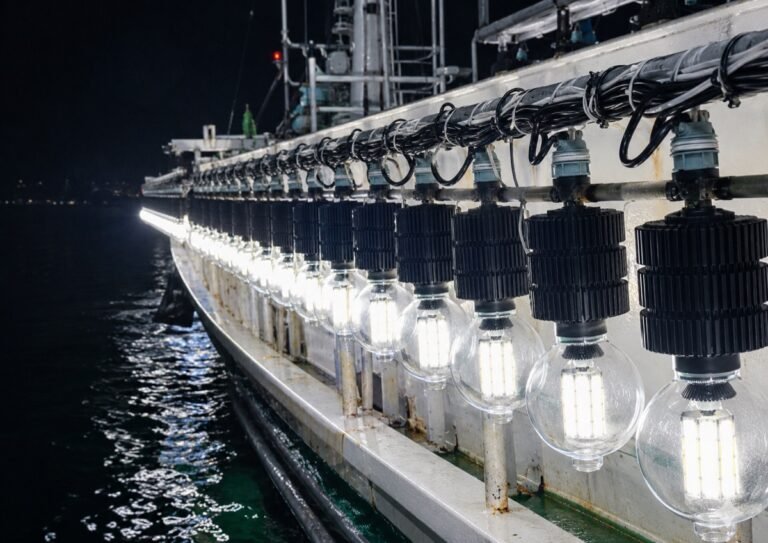
On a squid jigger, the useful question is not “How many watts does one lamp save?” It is “How does the complete lighting retrofit change generator loading, litres burned per fishing night, and catch per unit of fuel?” A lower nameplate wattage is a starting point, not a fuel-saving guarantee.
Build the real electrical baseline
Count every metal-halide lamp and record measured input power, including its ballast. Then log the other loads that stay on during fishing: winches, refrigeration, pumps, electronics and deck lighting. Repeat the measurement for the proposed LED system at the same operating point. The basic comparison is:
Lighting energy saved per night (kWh) = (existing lighting input kW − proposed lighting input kW) × operating hours.
For example, if a measured 60 kW lighting circuit becomes 36 kW and runs for 10 hours, the reduction is 240 kWh per night. This is an illustration, not an abylure vessel result. The generator’s actual fuel curve determines how many litres that 240 kWh represents. A lightly loaded generator can have a different litres-per-kWh result from one near its efficient operating range.
Convert energy into a defensible payback
Use the vessel’s fuel log to estimate litres per kWh at the old and new total loads, or measure fuel flow during matched fishing periods. Multiply the measured litres saved by local diesel price and annual fishing nights. Then adjust annual savings for changes in maintenance and spares. Divide the installed retrofit cost, including installation, by annual net savings for a simple payback estimate. Keep any catch change separate until a controlled fishing trial supports it.
Published work on 14 coastal squid-jigging boats found fuel savings from lower-energy LED and metal-halide combinations. One reported configuration estimated 24% savings; that finding belongs to those boats and conditions, not every retrofit. Catch performance also varied with vessel and season, so a buyer should compare fuel and catch together.
Questions to send with your RFQ
- How many lamps are fitted, and what are the measured lamp-plus-ballast kW?
- What are generator model, rated kW, typical fishing load and operating hours?
- What input voltage, frequency, lamp holder and mounting clearance are available?
- What sea area, target species and current catch/fuel records can be used for a trial?
abylure offers 500W, 600W, 800W and 1000W above-water LED platforms. Final input and photometric configuration must be confirmed for the project. Compare the product series, then send your vessel’s power budget for an engineering review.